Recently I did some maintenance on a existing ConfigMgr 2012 R2 environment. On the Primary Site server, which was very slow, I started task manager and see a 100% CPU usage. This because of the MsMpEng.exe proces which is the Antimalware Service. Strange because there are already some exceptions in place.
After adding some additional exclusions everthing went fine again. Just add the following exclusions for that:
Excluded files and folders:
-C:\Program Files\Microsoft Security Client\MsMpEng.exe
-C:\ProgramData\Microsoft\Microsoft Antimalware
Excluded processes:
-C:\Program Files\Microsoft Security Client\MsMpEng.exe
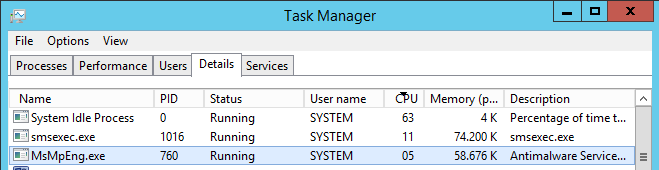
Much better this way. Still strange I didn't see this behavior before! When you have 100% CPU load on the Primary Site server (or other systems) too, just add this exclusions. Hope it helps!
Update: After one day the server is still in responsive state.
Showing posts with label SCEP. Show all posts
Tuesday, June 2, 2015
Microsoft Antimalware has 100% CPU load on the Primary Site server
Thursday, March 19, 2015
Installing SCEP 2012 - NIS updates during deployment
During deployment I'm using SCEP installation and update packages a lot. When using the script from Chris Nackers, new definitions can be downloaded automatically each day. Therefore a system is deployed with the latest SCEP update during deployment, and there's less security risk after deployment. Most of time SCEP installation, and antimalware/ antispyware (MPAM) updates goes fine, but Network Inspection System (NIS) updates goes wrong. Errors given are:
-Installation completed with exit code 0x80004005
-Installation failed with error (0x80004005)
-Install Software failed, hr=0x80004005. The operating system reported error 2147500037: Unspecified error
This because you're using the wrong version then. When looking on Microsoft Malware Protection Center, the following is mentioned:
1. Open your security software by double clicking on the icon in the system tray (you may need to click the arrow to see the icon) or, in Windows 8.1, search for Windows Defender:
2. Click the arrow next to Help and choose About:
3. Your software version number is displayed at the line labelled Antimalware Client Version
For version number 4.1.522.0 and above, you must download the Network Realtime Inspection definitions:
-For 32-bit versions of Windows, download 32-bit Network Realtime Inspection definitions
-For 64-bit versions of Windows, download 64-bit Network Realtime Inspection definitions
If you have a version number lower than 4.1.522.0, you must download the Network Inspection Service definitions:
-For 32-bit versions of Windows, download 32-bit Network Inspection Service definitions
-For 64-bit versions of Windows, download 64-bit Network Inspection Service definitions
So yes, there is a difference between Network Realtime Inspection (NRI) and Network Inspection Services (NIS) definitions.
Source: Malware Protection Center
More blogposts on this topic:
Install and update Endpoint Protection (SCEP) during a task sequence
-Installation completed with exit code 0x80004005
-Installation failed with error (0x80004005)
-Install Software failed, hr=0x80004005. The operating system reported error 2147500037: Unspecified error
This because you're using the wrong version then. When looking on Microsoft Malware Protection Center, the following is mentioned:
1. Open your security software by double clicking on the icon in the system tray (you may need to click the arrow to see the icon) or, in Windows 8.1, search for Windows Defender:
2. Click the arrow next to Help and choose About:
3. Your software version number is displayed at the line labelled Antimalware Client Version
For version number 4.1.522.0 and above, you must download the Network Realtime Inspection definitions:
-For 32-bit versions of Windows, download 32-bit Network Realtime Inspection definitions
-For 64-bit versions of Windows, download 64-bit Network Realtime Inspection definitions
If you have a version number lower than 4.1.522.0, you must download the Network Inspection Service definitions:
-For 32-bit versions of Windows, download 32-bit Network Inspection Service definitions
-For 64-bit versions of Windows, download 64-bit Network Inspection Service definitions
So yes, there is a difference between Network Realtime Inspection (NRI) and Network Inspection Services (NIS) definitions.
Source: Malware Protection Center
More blogposts on this topic:
Install and update Endpoint Protection (SCEP) during a task sequence
Labels:
0x80004005,
2147500037,
Endpoint Protection,
MPAM,
Network Inspection System,
NIS,
nis_full.exe,
SCEP
Monday, January 5, 2015
System Center Endpoint Protection Policy Templates
On Microsoft TechNet you can find System Center Endpoint Protection (SCEP)Policy Templates. At the moment there's v4 which is from 11/3/2014. These templates can be used to import in ConfigMgr 2012 (R2) easily. You can choose to create multiple server collections to deploy them, or merge them to a single server policy. Best thing is to copy them to the default folder, which is: <ConfigMgr folder>\AdminConsole\XmlStorage\EPTemplates.
The following SCEP policies are enclosed:
The queries to decide which server is a member in which collection is enclosed also:
-----
SCEP Server CLUSTER
select * from SMS_R_System inner join SMS_G_System_SERVICE on SMS_G_System_SERVICE.ResourceID = SMS_R_System.ResourceId where SMS_G_System_SERVICE.Name like "ClusSvc"
-----
SCEP Server EXCHANGE
select * from SMS_R_System inner join SMS_G_System_SERVICE on SMS_G_System_SERVICE.ResourceID = SMS_R_System.ResourceId where SMS_G_System_SERVICE.Name like "MSExchange%"
-----
SCEP Server HYPER-V
select * from SMS_R_System inner join SMS_G_System_SERVICE on SMS_G_System_SERVICE.ResourceID = SMS_R_System.ResourceId where SMS_G_System_SERVICE.Name like "vmms"
-----
SCEP Server IIS
select * from SMS_R_System inner join SMS_G_System_SERVICE on SMS_G_System_SERVICE.ResourceID = SMS_R_System.ResourceId where SMS_G_System_SERVICE.Name like "W3SVC"
-----
SCEP Server RDS
select * from SMS_R_System inner join SMS_G_System_SERVER_FEATURE on SMS_G_System_SERVER_FEATURE.ResourceID = SMS_R_System.ResourceId where SMS_G_System_SERVER_FEATURE.ID = 18
-----
SCEP Server SCCM
select * from SMS_R_System inner join SMS_G_System_SERVICE on SMS_G_System_SERVICE.ResourceID = SMS_R_System.ResourceId where SMS_G_System_SERVICE.Name like "SMS_SITE_COMPONENT_MANAGER"
-----
SCEP Server SCDPM
select * from SMS_R_System inner join SMS_G_System_SERVICE on SMS_G_System_SERVICE.ResourceId = SMS_R_System.ResourceId where SMS_G_System_SERVICE.Name like "MSDPM"
-----
SCEP Server SCO
select * from SMS_R_System inner join SMS_G_System_SERVICE on SMS_G_System_SERVICE.ResourceID = SMS_R_System.ResourceId where SMS_G_System_SERVICE.Name like "orunbook"
-----
SCEP Server SCOM
select * from SMS_R_System inner join SMS_G_System_SERVICE on SMS_G_System_SERVICE.ResourceID = SMS_R_System.ResourceId where SMS_G_System_SERVICE.Name like "cshost"
-----
SCEP Server SCSM
select * from SMS_R_System inner join SMS_G_System_SERVICE on SMS_G_System_SERVICE.ResourceID = SMS_R_System.ResourceId where SMS_G_System_SERVICE.Name like "OMCFG"
-----
SCEP Server SCVMM
select * from SMS_R_System inner join SMS_G_System_SERVICE on SMS_G_System_SERVICE.ResourceId = SMS_R_System.ResourceId where SMS_G_System_SERVICE.Name like "SCVMMService"
-----
SCEP Server SHAREPOINT
select * from SMS_R_System inner join SMS_G_System_SERVICE on SMS_G_System_SERVICE.ResourceId = SMS_R_System.ResourceId where SMS_G_System_SERVICE.Name like "SPTimer%"
-----
SCEP Server SQL
select * from SMS_R_System inner join SMS_G_System_SERVICE on SMS_G_System_SERVICE.ResourceID = SMS_R_System.ResourceId where SMS_G_System_SERVICE.Name like "MSSQL$%"
-----
SCEP Server WSUS
select * from SMS_R_System inner join SMS_G_System_SERVICE on SMS_G_System_SERVICE.ResourceId = SMS_R_System.ResourceId where SMS_G_System_SERVICE.Name like "WsusService"
-----
Source: Microsoft TechNet
Just great to have many SCEP templates to build on!
The following SCEP policies are enclosed:
The queries to decide which server is a member in which collection is enclosed also:
-----
SCEP Server CLUSTER
select * from SMS_R_System inner join SMS_G_System_SERVICE on SMS_G_System_SERVICE.ResourceID = SMS_R_System.ResourceId where SMS_G_System_SERVICE.Name like "ClusSvc"
-----
SCEP Server EXCHANGE
select * from SMS_R_System inner join SMS_G_System_SERVICE on SMS_G_System_SERVICE.ResourceID = SMS_R_System.ResourceId where SMS_G_System_SERVICE.Name like "MSExchange%"
-----
SCEP Server HYPER-V
select * from SMS_R_System inner join SMS_G_System_SERVICE on SMS_G_System_SERVICE.ResourceID = SMS_R_System.ResourceId where SMS_G_System_SERVICE.Name like "vmms"
-----
SCEP Server IIS
select * from SMS_R_System inner join SMS_G_System_SERVICE on SMS_G_System_SERVICE.ResourceID = SMS_R_System.ResourceId where SMS_G_System_SERVICE.Name like "W3SVC"
-----
SCEP Server RDS
select * from SMS_R_System inner join SMS_G_System_SERVER_FEATURE on SMS_G_System_SERVER_FEATURE.ResourceID = SMS_R_System.ResourceId where SMS_G_System_SERVER_FEATURE.ID = 18
-----
SCEP Server SCCM
select * from SMS_R_System inner join SMS_G_System_SERVICE on SMS_G_System_SERVICE.ResourceID = SMS_R_System.ResourceId where SMS_G_System_SERVICE.Name like "SMS_SITE_COMPONENT_MANAGER"
-----
SCEP Server SCDPM
select * from SMS_R_System inner join SMS_G_System_SERVICE on SMS_G_System_SERVICE.ResourceId = SMS_R_System.ResourceId where SMS_G_System_SERVICE.Name like "MSDPM"
-----
SCEP Server SCO
select * from SMS_R_System inner join SMS_G_System_SERVICE on SMS_G_System_SERVICE.ResourceID = SMS_R_System.ResourceId where SMS_G_System_SERVICE.Name like "orunbook"
-----
SCEP Server SCOM
select * from SMS_R_System inner join SMS_G_System_SERVICE on SMS_G_System_SERVICE.ResourceID = SMS_R_System.ResourceId where SMS_G_System_SERVICE.Name like "cshost"
-----
SCEP Server SCSM
select * from SMS_R_System inner join SMS_G_System_SERVICE on SMS_G_System_SERVICE.ResourceID = SMS_R_System.ResourceId where SMS_G_System_SERVICE.Name like "OMCFG"
-----
SCEP Server SCVMM
select * from SMS_R_System inner join SMS_G_System_SERVICE on SMS_G_System_SERVICE.ResourceId = SMS_R_System.ResourceId where SMS_G_System_SERVICE.Name like "SCVMMService"
-----
SCEP Server SHAREPOINT
select * from SMS_R_System inner join SMS_G_System_SERVICE on SMS_G_System_SERVICE.ResourceId = SMS_R_System.ResourceId where SMS_G_System_SERVICE.Name like "SPTimer%"
-----
SCEP Server SQL
select * from SMS_R_System inner join SMS_G_System_SERVICE on SMS_G_System_SERVICE.ResourceID = SMS_R_System.ResourceId where SMS_G_System_SERVICE.Name like "MSSQL$%"
-----
SCEP Server WSUS
select * from SMS_R_System inner join SMS_G_System_SERVICE on SMS_G_System_SERVICE.ResourceId = SMS_R_System.ResourceId where SMS_G_System_SERVICE.Name like "WsusService"
-----
Source: Microsoft TechNet
Just great to have many SCEP templates to build on!
Tuesday, June 3, 2014
Reboot needed after automatic update of Endpoint Protection
Yesterday I did some troubleshooting on Endpoint Protection (SCEP). This because SCEP was out-of-date (more then 30 days) on multiple servers. ConfigMgr has downloaded updates by Automatic Deployment Rule (ADR), but no updates were installed. No monitoring messages were seen on the SCEP dashboard, so strange issue indeed. Nothing to see in the different logfiles either..
Long story short, there was an "Update for System Center Endpoint Protection 2012 Client" installed last month, and because a reboot was suppressed in ADR, definition updates couldn't be installed anymore. After reboot of servers everything was working fine again. Pity that this couldn't be seen on the SCEP dashboard!
Note: Doing a repair on the ConfigMgr client (Console Extensions) did the trick also, so no need to reboot every server.
Source: Microsoft TechNet
- C:\Windows\WindowsUpdate.log
- C:\Windows\CCM\Logs\UpdatesDeployment.log
- C:\Windows\CCM\Logs\UpdatesHandler.log
- C:\Windows\CCM\Logs\UpdatesStore.log
- C:\Windows\CCM\Logs\WUAHandler.log
Long story short, there was an "Update for System Center Endpoint Protection 2012 Client" installed last month, and because a reboot was suppressed in ADR, definition updates couldn't be installed anymore. After reboot of servers everything was working fine again. Pity that this couldn't be seen on the SCEP dashboard!
Note: Doing a repair on the ConfigMgr client (Console Extensions) did the trick also, so no need to reboot every server.
Source: Microsoft TechNet
Monday, May 5, 2014
Install and update Endpoint Protection (SCEP) during a task sequence
In my daily job I'm doing a lot ConfigMgr and SCEP implementations. Sometimes Endpoint Protection (SCEP) is installed for antivirus and antimalware usage. During installation the SCEP client can be installed and an export of the SCEP policy can be applied. After the task sequence is done the SCEP client still needs to be updated however. This can be done during the task sequence also. Let's have a look.
The SCEP client can be installed with a ConfigMgr package. Just use a program like this: "SCEPInstall.exe /policy <policy>.xml". More about that can be found here: css-security.com
The SCEP definitions can be updated during a task sequence also. That way new definitions can be installed during OS deployment. More about that can be found here: chrisnackers.com
When using the SCEP definitions a VBS script is used, which downloads new MPAM and NIS definitions each day. When using a scheduled task this will be done automatically. The SCEP definitions package can be synchronized on the ConfigMgr Distribution point daily within package properties. This is needed to deploy the package with the new content downloaded. No SCEP installation with old definitions anymore :)
Download: EP_Definitions.vbs
The definitions updates can be found on the following location:
-Endpoint Protection antimalware definition update (x86)
-Endpoint Protection antimalware definition update (x64)
-Network Inspection System definition updates (x86)
-Network Inspection System definition updates (x64)
Just use above configuration to automate installation and daily SCEP definitions, so a up-to-date SCEP client will be installed always.
Just great, isn't it!?
The SCEP client can be installed with a ConfigMgr package. Just use a program like this: "SCEPInstall.exe /policy <policy>.xml". More about that can be found here: css-security.com
The SCEP definitions can be updated during a task sequence also. That way new definitions can be installed during OS deployment. More about that can be found here: chrisnackers.com
When using the SCEP definitions a VBS script is used, which downloads new MPAM and NIS definitions each day. When using a scheduled task this will be done automatically. The SCEP definitions package can be synchronized on the ConfigMgr Distribution point daily within package properties. This is needed to deploy the package with the new content downloaded. No SCEP installation with old definitions anymore :)
Download: EP_Definitions.vbs
The definitions updates can be found on the following location:
-Endpoint Protection antimalware definition update (x86)
-Endpoint Protection antimalware definition update (x64)
-Network Inspection System definition updates (x86)
-Network Inspection System definition updates (x64)
Just use above configuration to automate installation and daily SCEP definitions, so a up-to-date SCEP client will be installed always.
Just great, isn't it!?
Thursday, February 20, 2014
How to configure Endpoint Protection Malware detection E-Mail Alerts
Within Endpoint Protection (SCEP) you can have antivirus/antimalware functionality by adding the Endpoint Protection role. That way (by Client settings) the SCEP agent can be installed on systems. With antimalware policies you can decide how the SCEP agent behaves and which exclusions to set. There is also a nice dashboard for total overview and malware detected. In this blogpost I will explain how Malware detection E-Mail Alerts can be configured.
First Email notification must be set. this can be found in Administration > Sites > Configure Site Components > Email Notification. Just enable the rule (Enable email notification for alerts), type in FQDN or IP-address of the SMTP server, sender address and "Test SMTP Server". That way you know for sure if communication is done okay.
After that choose properties on the collection where you want the E-Mail Alert. Choose Alerts and enable the rule (View this collection in the Endpoint Protection dashboard). Click Add and choose the four Endpoint Protection options, which are Malware detection, Malware outbreak, Repeated malware detection and Multiple malware detection. Leave default settings on the other options (Alert name, Alert severity and Malware detection threshold).
When above is done go to the Monitoring tab, choose Alerts > Subscriptions, and "create subscription". Type in a Subscription name, Email address and tick the four Endpoint Protection options again, which are Malware detection, Malware outbreak, Repeated malware detection and Multiple malware detection. Then everything is done and a test is needed to see if the E-Mail Alert is working.
Just create a EICAR test file (http://www.eicar.org/86-0-Intended-use.html) and let's see what happens. if everything is done well an E-Mail Alert will be received after a few minutes. In my case multiple E-Mail Alerts were received: Malware detection alert, Malware outbreak alert and Repeated malware detection alert. Hope it will be clear this way how to configure Malware detection E-Mail Alerts.
First Email notification must be set. this can be found in Administration > Sites > Configure Site Components > Email Notification. Just enable the rule (Enable email notification for alerts), type in FQDN or IP-address of the SMTP server, sender address and "Test SMTP Server". That way you know for sure if communication is done okay.
After that choose properties on the collection where you want the E-Mail Alert. Choose Alerts and enable the rule (View this collection in the Endpoint Protection dashboard). Click Add and choose the four Endpoint Protection options, which are Malware detection, Malware outbreak, Repeated malware detection and Multiple malware detection. Leave default settings on the other options (Alert name, Alert severity and Malware detection threshold).
When above is done go to the Monitoring tab, choose Alerts > Subscriptions, and "create subscription". Type in a Subscription name, Email address and tick the four Endpoint Protection options again, which are Malware detection, Malware outbreak, Repeated malware detection and Multiple malware detection. Then everything is done and a test is needed to see if the E-Mail Alert is working.
Just create a EICAR test file (http://www.eicar.org/86-0-Intended-use.html) and let's see what happens. if everything is done well an E-Mail Alert will be received after a few minutes. In my case multiple E-Mail Alerts were received: Malware detection alert, Malware outbreak alert and Repeated malware detection alert. Hope it will be clear this way how to configure Malware detection E-Mail Alerts.
Wednesday, December 18, 2013
Multiple anti-malware policies visible in Endpoint Protection 2012 R2
In SCCM 2012 with Service Pack 1 (SP1) with Endpoint Protection (SCEP) it was needed to look in registry when multiple anti-malware policies were active. More about that here: Prepare ConfigMgr client for Sysprep or Master Image.
It mentions: The policy name in SCEP will be named "Antimalware policy" by default. All SCEP policies applied can be found in registry: "HKLM\Software\Microsoft\CCM\EPAgent\LastAppliedPolicy"
In SCCM 2012 Release 2 (R2) this isn't needed anymore. This because multiple anti-malware policies are displayed in the SCEP client now. Much better this way isn't it!?
It mentions: The policy name in SCEP will be named "Antimalware policy" by default. All SCEP policies applied can be found in registry: "HKLM\Software\Microsoft\CCM\EPAgent\LastAppliedPolicy"
In SCCM 2012 Release 2 (R2) this isn't needed anymore. This because multiple anti-malware policies are displayed in the SCEP client now. Much better this way isn't it!?
Wednesday, November 13, 2013
SCEP updates pushed out to clients through SCCM 2012
Last week I had an issue on my ConfigMgr server with local WSUS installation. After fixing WSUS in a earlier blogpost, Definition Updates didn't install on my systems. This because of a Group Policy (GPO) which was set by a colleague ;) The following was seen in the WUAHandler log: Group policy settings were overwritten by a higher authority (Domain Controller). The GPO just had the server name and port (SCCM01:8530) and SCCM had the FQDN and port (SCCM01.Contoso.local:8530).
Lucky me I found the issue reading the following post:
EP updates pushed out to clients through SCCM 2012
http://social.technet.microsoft.com/Forums/forefront/en-US/a9bb6c1c-1473-4fe7-bf1d-a689792c8100/ep-updates-pushed-out-to-clients-through-sccm-2012?forum=FCSNext
It mentions: It looks like there was a conflict on how the WSUS server was defined in Group Policy versus what SCCM had (GP just had the server name and port and SCCM had the FQDN and port). Once I removed the GP setting all together and updated the policy etc then it seemed like things started to happen. In the UpdateDeployment.log I was seeing these errors:
Job error (0x87d00692) received for assignment ({76d342f7-e312-4c6d-9c60-29be10cc5212}) action
The setup recommends the short name for your GPO but I wasn't seeing deployments reach any of the endpoints. Changing to the FQDN of the server in the GPO fixed the issue and I'm now seeing percentage completed stats and deployments working.
What you have to do is use a GPO with only "Specify intranet Microsoft update service location" (FQDN) & "Allow Automatic Updates immediate installation". When using FQDN for update management above error messages are gone. This time it will work fine again!
![]() |
| Sample from WindowsUpdate.log |
| Sample from WUAHandler.log |
Lucky me I found the issue reading the following post:
EP updates pushed out to clients through SCCM 2012
http://social.technet.microsoft.com/Forums/forefront/en-US/a9bb6c1c-1473-4fe7-bf1d-a689792c8100/ep-updates-pushed-out-to-clients-through-sccm-2012?forum=FCSNext
It mentions: It looks like there was a conflict on how the WSUS server was defined in Group Policy versus what SCCM had (GP just had the server name and port and SCCM had the FQDN and port). Once I removed the GP setting all together and updated the policy etc then it seemed like things started to happen. In the UpdateDeployment.log I was seeing these errors:
Job error (0x87d00692) received for assignment ({76d342f7-e312-4c6d-9c60-29be10cc5212}) action
The setup recommends the short name for your GPO but I wasn't seeing deployments reach any of the endpoints. Changing to the FQDN of the server in the GPO fixed the issue and I'm now seeing percentage completed stats and deployments working.
What you have to do is use a GPO with only "Specify intranet Microsoft update service location" (FQDN) & "Allow Automatic Updates immediate installation". When using FQDN for update management above error messages are gone. This time it will work fine again!
Thursday, November 1, 2012
System Center 2012 Endpoint Protection (part 3)
Last time I wrote a blogpost about System Center 2012 Endpoint Protection (SCEP) functionality. I mentioned the installation/configuration and deploying SCEP agents (Part 1), and deploying antimalware policies & definition updates (Part 2). This time the SCEP series continues with monitoring, dashboard views and reports. When antimalware policies and definition updates are in place, it's time to have a look at monitoring the SCEP agents. There are multiple functionalities for that.
Let's start with the SCEP dashboard first.
Beneath Monitoring, the "System Center 2012 Endpoint Protection Status" can be found. This is THE dashboard for viewing Security State (Client status, Malware remediation status, Top 5 malware by number of computers) and Operational State (Operational status of clients, Definition status on computers). It can be viewed for all collections where an anti-malware policy is deployed too. Because I deploy it to ALL servers and clients (most of time), I've selected the "All Desktop and Server Clients" collection here.
Nice thing is, it's completely dynamic. You can click on all Links and graphical stuff to go to the relevant system(s). After clicking a Link or graphical item, a specific SCEP collection is showed with systems and ALL (Deployment state, Policy name, Policy application state, Definition last version, Remediation status) Endpoint Protection information. From default collections there are buttons for SCEP available too. Both Endpoint Protection status and Malware details can be watched here. SCEP is integrated on multiple places in the console.
When looking at Reports, there are six SCEP reports available. Most usable ones are "Antimalware activity report" and Dashboard. Both have a nice graphical layout by default. When rightclick on a report it's possible to select "Create Subscription", which generates a report on a scheduled time. Reports can be delivered by Windows File Share and E-mail this way. You can define the Render format also, which can be: XML, CSV, TIFF, PDF, (M)HTML, RPL, Excel and Word files.
My personal conclusion:
Microsoft did a great job with SCEP integration in ConfigMgr 2012, with: automatic SCEP client deployment, multiple policies which can be merged, a very nice dynamic dashboard, automatic deployment rules for definition updates & beautiful reports which can be delivered multiple ways and saved in multiple formats! Therefore I recommend customers for using SCEP all the time. SCEP integration in ConfigMgr 2012 is the best antivirus solution there is!
Let's start with the SCEP dashboard first.
Beneath Monitoring, the "System Center 2012 Endpoint Protection Status" can be found. This is THE dashboard for viewing Security State (Client status, Malware remediation status, Top 5 malware by number of computers) and Operational State (Operational status of clients, Definition status on computers). It can be viewed for all collections where an anti-malware policy is deployed too. Because I deploy it to ALL servers and clients (most of time), I've selected the "All Desktop and Server Clients" collection here.
Nice thing is, it's completely dynamic. You can click on all Links and graphical stuff to go to the relevant system(s). After clicking a Link or graphical item, a specific SCEP collection is showed with systems and ALL (Deployment state, Policy name, Policy application state, Definition last version, Remediation status) Endpoint Protection information. From default collections there are buttons for SCEP available too. Both Endpoint Protection status and Malware details can be watched here. SCEP is integrated on multiple places in the console.
When looking at Reports, there are six SCEP reports available. Most usable ones are "Antimalware activity report" and Dashboard. Both have a nice graphical layout by default. When rightclick on a report it's possible to select "Create Subscription", which generates a report on a scheduled time. Reports can be delivered by Windows File Share and E-mail this way. You can define the Render format also, which can be: XML, CSV, TIFF, PDF, (M)HTML, RPL, Excel and Word files.
My personal conclusion:
Microsoft did a great job with SCEP integration in ConfigMgr 2012, with: automatic SCEP client deployment, multiple policies which can be merged, a very nice dynamic dashboard, automatic deployment rules for definition updates & beautiful reports which can be delivered multiple ways and saved in multiple formats! Therefore I recommend customers for using SCEP all the time. SCEP integration in ConfigMgr 2012 is the best antivirus solution there is!
Monday, October 29, 2012
System Center 2012 Endpoint Protection (part 2)
Last time I wrote a blogpost about System Center 2012 Endpoint Protection (SCEP) functionality. I mentioned the installation/configuration and deploying SCEP agents. This time the SCEP series continues with deploying antimalware policies and definition updates. With a SCEP agent installed it's time to manage them with antimalware policies, and make sure definition updates will be installed every 8 hours (if available).
Beneath "Assets and Compliance" there's a folder for creating and managing Antimalware and Windows Firewall policies. Looking at antimalware policies there is a Default Client Antimalware Policy. Just leave it at default settings and create a new policy. Just rightclick and choose "Create Antimalware Policy" or "Import". In my case I'm using Import, and choose default policies for all type of servers being used. That way most values and exclusions are set by default, which can save you a lot of configuration time.
Nice thing is you can merge multiple policies to one single policy now. That functionality wasn't available in the earlier Forefront Endpoint Protection (FEP) 2010 release. When importing (for example) both Domain Controller, DNS Server and DHCP Server policies, you can merge them to one single policy when needed. You can select a Base policy and New policy name also. That way it's a lot easier to create new antimalware policies. Just have a look at the screenshot how it looks like.
Another important step is to configure automatic definition updates. In ConfigMgr 2007 with FEP 2010 it was needed to use the "Definition Update Automation Tool" in combination with a Task Scheduler. More about that in the following blogposts HERE and HERE. In ConfigMgr 2012 you can use "Automatic Deployment Rules" for that. Just create a new rule, select Search criteria based on FEP 2010 and deploy it. In my case I deployed it on the "All Desktop and Server Clients" collection. That way all clients with a SCEP agent will automatically receive new updates.
Both antimalware policies and definition updates are in place now!
My next blogpost will be about deploying monitoring, dashboard views and reports. Stay tuned for more!
Beneath "Assets and Compliance" there's a folder for creating and managing Antimalware and Windows Firewall policies. Looking at antimalware policies there is a Default Client Antimalware Policy. Just leave it at default settings and create a new policy. Just rightclick and choose "Create Antimalware Policy" or "Import". In my case I'm using Import, and choose default policies for all type of servers being used. That way most values and exclusions are set by default, which can save you a lot of configuration time.
Nice thing is you can merge multiple policies to one single policy now. That functionality wasn't available in the earlier Forefront Endpoint Protection (FEP) 2010 release. When importing (for example) both Domain Controller, DNS Server and DHCP Server policies, you can merge them to one single policy when needed. You can select a Base policy and New policy name also. That way it's a lot easier to create new antimalware policies. Just have a look at the screenshot how it looks like.
Another important step is to configure automatic definition updates. In ConfigMgr 2007 with FEP 2010 it was needed to use the "Definition Update Automation Tool" in combination with a Task Scheduler. More about that in the following blogposts HERE and HERE. In ConfigMgr 2012 you can use "Automatic Deployment Rules" for that. Just create a new rule, select Search criteria based on FEP 2010 and deploy it. In my case I deployed it on the "All Desktop and Server Clients" collection. That way all clients with a SCEP agent will automatically receive new updates.
Both antimalware policies and definition updates are in place now!
My next blogpost will be about deploying monitoring, dashboard views and reports. Stay tuned for more!
Monday, October 22, 2012
System Center 2012 Endpoint Protection (part 1)
Last week I installed System Center 2012 Endpoint Protection (SCEP) at my office. SCEP is built on Configuration Manager (ConfigMgr) 2012, creating a single infrastructure for deploying and managing endpoint protection. SCEP uses the same industry-leading antimalware engine as Microsoft Security Essentials and Windows Defender (Windows 8), to protect systems against the latest malware and rootkits. SCEP is previously known as Forefront Endpoint Protection (FEP) 2010.
In this series of blogposts I will mention the installation/configuration and deploying SCEP agents (1), deploying antimalware policies and definition updates (2), monitoring, dashboard views and reports (3).
Let's mention the installation/configuration first.
In ConfigMgr 2007 it was needed to install and integrate FEP 2010 within the ConfigMgr console. More about that HERE. In ConfigMgr 2012 it will be a lot easier than that! Just install the Endpoint Protection point role on your ConfigMgr Site server. That way it will be activated in your environment. No need to create a software package or something like that. This will be created by default also.
Beneath "Assets and Compliance" there will be a folder for creating and managing policies. Beneath "Monitoring" there will be a Dashboard for SCEP 2012 status. In Reports there will be six reports to run. During ConfigMgr 2012 agent install, the CCMSETUP folder will be used for ConfigMgr and SCEP installation. The file SCEPInstall.exe will be download by default also. This file is used for SCEP agent installation.
Normally, SCEP installation is disabled within the ConfigMgr agent policy. Beneath "Administration" there is a Client Settings policy. Just leave it at default settings and create a new Client Settings policy. Within this new policy, enable Endpoint Protection and deploy it on a collection which must have Endpoint Protection. In my case I deployed it on the "All Desktop and Server Clients" collection. That way ALL clients with a ConfigMgr agent will also have SCEP installed automatically.
Both installation/configuration and deploy SCEP agents are done now!
My next blogpost will be about deploying antimalware policies and definition updates. Stay tuned for more!
In this series of blogposts I will mention the installation/configuration and deploying SCEP agents (1), deploying antimalware policies and definition updates (2), monitoring, dashboard views and reports (3).
Let's mention the installation/configuration first.
In ConfigMgr 2007 it was needed to install and integrate FEP 2010 within the ConfigMgr console. More about that HERE. In ConfigMgr 2012 it will be a lot easier than that! Just install the Endpoint Protection point role on your ConfigMgr Site server. That way it will be activated in your environment. No need to create a software package or something like that. This will be created by default also.
Beneath "Assets and Compliance" there will be a folder for creating and managing policies. Beneath "Monitoring" there will be a Dashboard for SCEP 2012 status. In Reports there will be six reports to run. During ConfigMgr 2012 agent install, the CCMSETUP folder will be used for ConfigMgr and SCEP installation. The file SCEPInstall.exe will be download by default also. This file is used for SCEP agent installation.
Normally, SCEP installation is disabled within the ConfigMgr agent policy. Beneath "Administration" there is a Client Settings policy. Just leave it at default settings and create a new Client Settings policy. Within this new policy, enable Endpoint Protection and deploy it on a collection which must have Endpoint Protection. In my case I deployed it on the "All Desktop and Server Clients" collection. That way ALL clients with a ConfigMgr agent will also have SCEP installed automatically.
Both installation/configuration and deploy SCEP agents are done now!
My next blogpost will be about deploying antimalware policies and definition updates. Stay tuned for more!
Subscribe to:
Posts (Atom)


